

Hey there, welcome back to Grounded Ramblings BlogCast!
I’m Crish, army veteran, retired cop, lifelong martial arts practitioner and solopreneur in my 50s, trying to make sense of combat sports without all the bs.
Today we’re diving into Episode 15: Conceptual Systems Part 2 — Zahabi, Giles, Jones, Ryan, Biernacki.
By the end, you’ll see how five very different instructors each built a different kind of map for jiu-jitsu. Some are clean and efficient. Some are modern and aggressive. Some are quietly brilliant. And one honourable mention is so radical it deserves its own chapter entirely.
We’ll talk efficiency, pressure, concept over chaos, building a system from nothing, and the one Estonian who decided that simply surviving was a complete art form in itself.
Stick around till the end and drop a comment: which of these systems speaks to the grappler you actually are right now, not the one you were ten years ago?
Chapter 1!
The Map Gets More Interesting
Welcome back.
If you caught Episode 14, you’ll know we spent time with the heavy hitters of conceptual jiu-jitsu. Danaher, Roger Gracie, Thornton, Ryan Hall, Lovato.. Five very different thinkers who each tried to turn the chaos of grappling into something learnable, something teachable, something that could survive contact with reality.
But there’s a second wave. And this one is, in many ways, more accessible. More modern. More concerned with the question that matters most for grapplers like me: can this actually be used by someone who isn’t a full-time athlete?
Firas Zahabi is a Montréal-based coach who trained under John Danaher and built Tristar Gym into one of the most respected facilities in combat sports.
Lachlan Giles is an Australian black belt who has competed at the highest level while also becoming one of the clearest instructors in the game.
Craig Jones is another Australian no-gi specialist with a sharp strategic mind and a very direct approach to submission hunting.
Gordon Ryan is the closest thing to a system-building machine that modern no-gi has ever produced. And Rob Biernacki is the quiet Canadian who has been asking the hardest questions about how people actually learn this stuff.
Each of them has something real to offer. Each of them also has something that doesn’t translate perfectly to every body, every gym, every age group. And that gap is exactly where we’re going to spend this episode.

Chapter 2!
Why These Five? And Why Now?
Here’s the honest truth about why this particular group draws me in.
They’re not distant legends. They’re not founding fathers. They’re coaches who are working right now, building material, putting it out into the world, and asking other people to test it. That matters because it means there’s a feedback loop. There’s video, there are interviews, there are students, and there are failures on the record.
For someone like me; 53, blue belt, training at Absolute MMA in Melbourne after a career that involved real violence, real stress, and a body that carries both, the question isn’t who has the most beautiful system on paper.
The question is who has built something that actually survives contact with people who are tired, anxious, and don’t have unlimited time?
I’m not training to compete at ADCC. I’m training to stay useful, stay sharp, and stay on the mats for another decade. That means I need systems that are efficient. Systems that don’t rely on young knees or a fresh nervous system. Systems that make sense when someone explains them once and your brain is already halfway to sleep.
So when I look at these five, I’m not grading them on their competition records. I’m grading them on whether their ideas translate down the food chain. From world champions to blue belts. From full-time athletes to people who train twice a week if they’re lucky. That’s the filter. Same as last episode. The body I bring to the mats is the measuring stick.

Chapter 3!
Firas Zahabi — The Efficiency Engineer
Firas Zahabi got his black belt from John Danaher in 2011 and has spent most of his career coaching MMA fighters at Tristar Gym in Montréal, where he played a central role in building GSP into one of the most technically complete fighters in UFC history.
His core philosophy is surprisingly simple: don’t waste anything. Every movement should have a purpose. Every position should serve the next one.. His approach to training itself is equally distinctive; he doesn’t want his athletes going all-out in every session, because he believes recovery is part of the plan, not an afterthought.
For someone who spent years watching police officers burn out, overtrain, and come back broken, that idea lands hard. Zahabi treats the body as a long-term investment, not a short-term tool. You’re not supposed to empty the tank in the gym and then drag yourself to the job. You’re supposed to leave training with something left in reserve.
His conceptual work focuses on control before submission. Don’t chase the finish if the foundation isn’t there. Don’t reach for the arm if the base isn’t solid. That kind of discipline is rare, especially when you’re starting out and every roll feels like a chance to prove something.
The honest downside? Zahabi’s efficiency can feel conservative to younger grapplers who want to move fast and take risks. His approach rewards patience, and patience is something most people have to learn the hard way. But for a 53-year-old blue belt who needs to train tomorrow as well as today? Zahabi’s filter is one of the most useful ones I’ve found.

Chapter 4!
Lachlan Giles — The People’s Teacher
Lachlan Giles is Australian, which already makes him interesting to me, because it means he built his game without being surrounded by the same infrastructure that Brazilian or American grapplers take for granted.
He’s competed at the highest levels; his heel hook run at ADCC 2019 is still one of the most remarkable things to happen in modern grappling, but what separates him as an instructor is his ability to take a genuinely complex idea and make it feel manageable. His work on guard retention, half guard, and leg locks isn’t just technically sound, it’s structured. He gives you mental frameworks, not just physical shapes. He explains why a position matters, what the principle underneath it is, and then gives you a clear pathway to apply it.
For someone who has spent years teaching in high-stakes environments where a confused student isn’t just embarrassed but actually at risk, that quality stands out immediately. The best instructors in any field don’t just know the content. They understand how people absorb it, where they get confused, and what order things need to be presented in so the pieces actually click.
The honest limitation is that his material can be quite modern and sport-oriented. His leg lock system is brilliant, but it assumes a level of hip mobility and positional comfort that not every student walks in with on day one. That said, if I’m pointing a newer grappler toward one Australian instructor and saying “start here,” it would be Giles. Because he respects the student’s time, and that’s not nothing.

Chapter 5!
Craig Jones — The Strategic Pragmatist
Craig Jones is interesting because he doesn’t sound like a philosopher. He sounds like a bloke who’s worked out a few things on the mat and is happy to tell you about them, without dressing it up too much.
That’s part of his appeal. His instruction is direct. He doesn’t wrap ideas in a lot of language. He shows you the position, explains the logic, and trusts you to get on with it. His work on leg locks and guard passing is built around strategic thinking: which positions give you the most options, which submissions are most reliable under pressure, and where to invest your training time for the biggest return.
That kind of thinking is deeply practical. It’s the kind of map a working professional needs: not everything is equally important, so work out what is and spend your time there.
Jones also has a competitive track record that validates the system.. He’s not theorising from the sideline. He’s been pressure-tested at the highest levels of no-gi grappling and his approach has held up. That matters, because there is a lot of instructional content out there from people who can explain things well but have never been in a real fire.
The limitation is that Jones’s game is heavily no-gi and submission-oriented. If you’re training primarily in the gi, or looking for a complete game rather than a sharp submission-hunting toolkit, his material fills some gaps but not all of them. He’s not trying to teach you everything. He’s teaching you the highest-percentage things, and that requires you to bring something else to the table as well.

Chapter 6!
Gordon Ryan — The System Architect…
Gordon Ryan is the most extreme version of the idea running through this whole episode: that jiu-jitsu can be built from the ground up, deliberately, position by position, until you have a machine that almost never breaks down.
His approach is methodical to a degree that most people find either inspiring or exhausting, depending on the day. He maps positions, identifies the failure points, builds counters, then builds counters to the counters, and runs it all through live training until the system holds.. He’s spoken publicly about spending weeks deliberately losing in training while testing new approaches, because he understands that short-term failure is part of building something that lasts.
That kind of commitment is extraordinary, but it’s also very difficult to replicate for anyone with a job, a family, and a nervous system that can’t absorb that kind of volume. Ryan is a full-time professional with a team and the ability to do this as his entire life.. Most of us can admire the architecture without being able to copy the construction process.

Chapter 7!
Rob Biernacki — Concept Over Chaos
Rob Biernacki is probably the least famous name in this episode, but he might be the most important one for instructors.
He’s the head instructor at Island Top Team in Nanaimo, British Columbia, and the founder of BJJ Concepts. His work is built around one clear idea: before you teach a technique, make sure the student understands the concept underneath it. Alignment. Structure. Posture. The reason a grip works or doesn’t work. The reason a pass goes through or gets stopped.
His gamification of learning, what he calls “micro battles,” small positional games that isolate specific problems, is one of the most practically useful teaching tools I’ve come across in this whole journey. Instead of drilling a technique for repetition’s sake, you put the student in the exact situation where that concept matters, give them a small and clear goal, and let them problem-solve their way through it.
For someone who has taught in environments where people need to learn fast and retain under stress, that model is compelling. It’s also honest about how learning actually works. People don’t get better by watching techniques. They get better by solving problems, failing, adjusting, and solving again.
The limitation is that his approach requires instructors who are confident enough in the principles to let go of the script. If you’re only comfortable teaching step-by-step sequences, his model can feel unsettling. But if you trust it, it produces students who understand what they’re doing, not just students who can perform a sequence when conditions happen to be perfect.
Chapter 8!
Honourable Mention — Priit Mihkelson: The Defensive Revolutionary
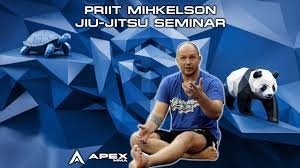
Priit Mihkelson is Estonian, which is already an unusual start for a story about Brazilian Jiu-Jitsu. He’s built something genuinely different: a system that puts survival and defence at the centre, not as a last resort, but as a deliberate strategy.
His framework is built around specific defensive shapes — the Grilled Chicken, the Hawking, the Turbo Guard — that are designed to make you very hard to submit, even from dominant positions. They’re not elegant.. They’re not flashy. They look a bit like someone who’s decided to become a problem rather than a threat. But they work, and they work especially well for people who don’t have the explosiveness or the technique to escape through conventional means.
For older grapplers, for people with injuries, for people who just need to survive long enough on the mat to give their brain a chance to catch up with what’s happening, this is a genuinely useful system. The ability to not get submitted is a skill, and Mihkelson has turned it into an art form. He gets the honourable mention rather than a full chapter because his system is more of a defensive layer than a complete game. You still need an offensive framework to build around it. But as a survival toolkit for grapplers who find themselves overwhelmed and outnumbered on the mat, there is nothing quite like it in the modern game.
Chapter 9!
The Pros and Cons — What These Systems Get Right and Wrong
Across these five instructors, the strengths of conceptual systems start to look familiar.
They give you a filter. Instead of trying to learn everything, you learn a framework that helps you decide what matters and what doesn’t. That’s enormously valuable for adult learners who don’t have unlimited time or an unlimited body. These systems also give you something to think about between training sessions — a way to mentally rehearse and problem-solve without needing to be on the mat. For older grapplers, that mental layer is one of the few real edges you have over younger, more athletic training partners.
But the risks are real too. Conceptual systems can create overthinkers... People who have a beautiful mental model of jiu-jitsu but freeze when the scramble starts because nothing looks like the diagram. They can also become identities rather than tools. You start to define yourself as a “Giles guy” or a “Ryan guy” and suddenly you’re defending a brand instead of just trying to learn.
The biggest danger of all is that conceptual knowledge becomes a substitute for live training.. You can watch instructionals, read theory, discuss principles in online forums — and feel like you’re improving while actually just getting more comfortable with ideas. The mat doesn’t care how good your mental model is. Only the roll tells the truth.

Chapter 10!
My Personal View — The System I’m Actually Building
After sitting with these five instructors and with the five from Episode 14, the picture that keeps coming back to me is this: the best system is the one that you’ll actually use, under pressure, when you’re tired and things are going wrong.
From Zahabi, I take efficiency and recovery. Don’t waste movement, and don’t waste the body that’s supposed to carry you back to the mat next week.
From Giles, I take structure and patience. Break things into learnable layers and trust the student to climb them.
From Jones, I take strategic honesty. Not everything is worth learning. Work out what is.
From Ryan, I take the builder’s mindset. Don’t just collect techniques, build a game with a direction and a logic.
From Biernacki, I take the concept-first principle. If the student doesn’t understand the why, the how will fall apart under pressure.
And from Mihkelson, I take the reminder that surviving is not nothing. Teaching someone to be genuinely hard to submit is teaching them something real.
My own version sits somewhere in the middle of all of these ideas. I want systems that work for tired people. Systems that are honest about what they cost and what they require. And above all, I want jiu-jitsu that keeps people on the mat, keeps them safe, and gives them something real to come back for.
Because the best system in the world is worthless if the student burns out, breaks down, or just stops showing up.
That’s my takeaway from Conceptual Systems Part 2. And if you’ve made it this far drop a comment: which of these five speaks to where you actually are on the mats right now?