

Chapter 1 – The New Big Question
When I left bare-knuckle wars for BJJ, everyone said, “This is the gentle art, it’s for everyone.” But as a midlife cop with Kyokushin scars and a nervous lower back, I kept running into the same problem: my “fundamentals” weren’t enough against younger, more specialised grapplers.
Episode 12 showed how the Gracies proved that leverage and guard could beat raw power, but they also left gaps; wrestling, leg locks, training methods, that my body and career could no longer ignore. So, here’s the big question of Episode 13:
If the Gracies built the house, did the next generation of innovators quietly remodel it for people like us, or accidentally made it even less liveable-
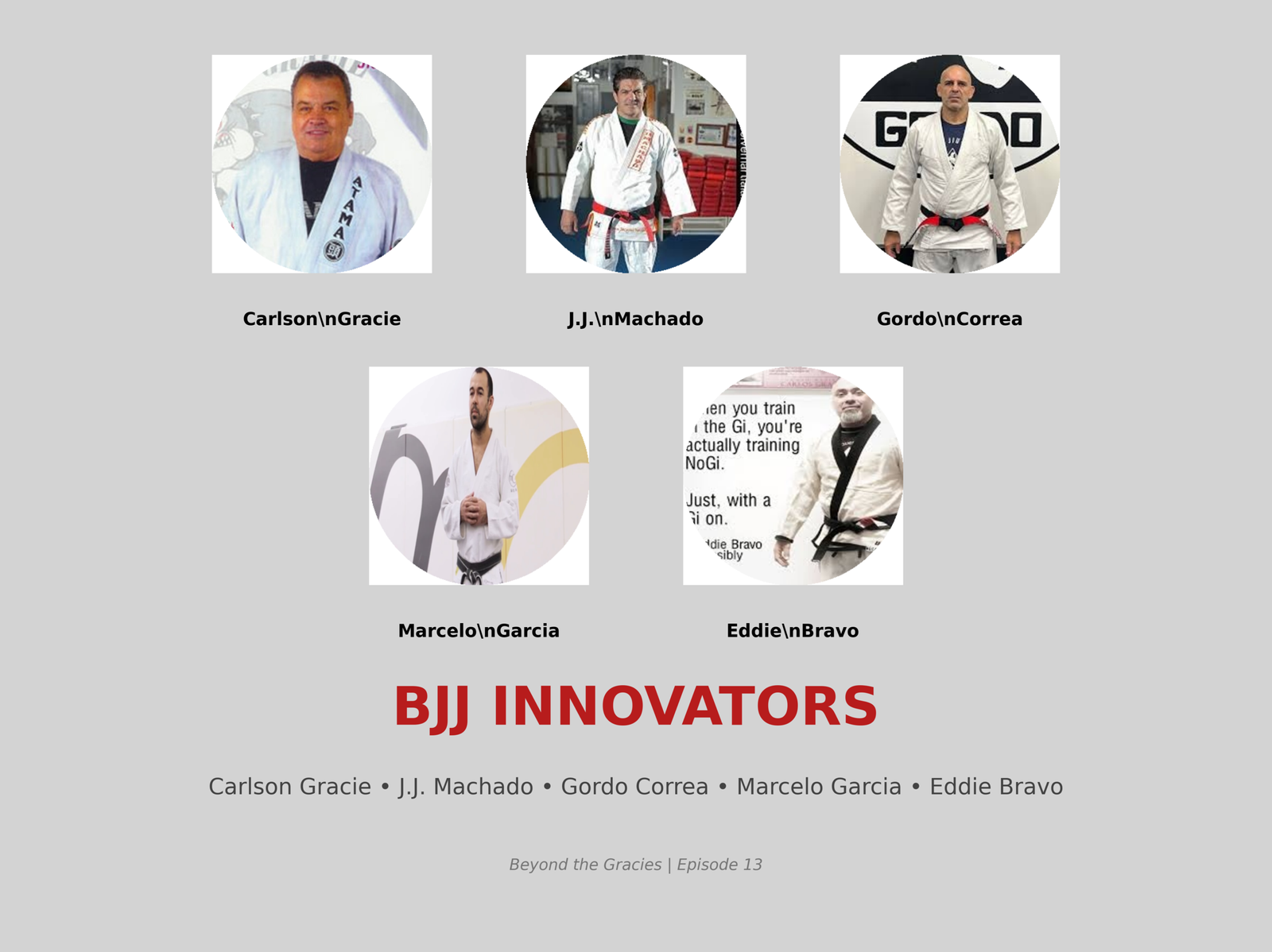
To answer that, we need to look at five rebels: Carlson Gracie, Jean Jacques Machado, Roberto “Gordo” Correa, Marcelo Garcia, and Eddie Bravo. They solved problems the pioneers couldn’t or wouldn’t solve, but they also dragged jiu-jitsu into culture wars; pure vs sporty vs weird, that you and I now inherit every time we pick a gym or a game.
So, as we walk through each innovator, I want you to keep asking:
What kind of grappler am I becoming, and is that actually who I want to be?
Chapter 2 – Carlson Gracie: The People’s Pitbull
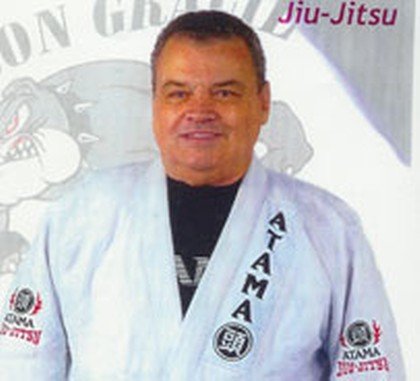
Carlson Gracie was Helio’s nephew and, in many ways, the family rebel. Where Helio emphasised survival and self-defence, Carlson doubled down on aggression, athleticism, and team competition, building one of the most feared academies in Rio from the 1960s through the 1990s.
He broke with family tradition by teaching “common people,” not just relatives and private students, and he trained fighters specifically to beat Helio’s sons, think of Wallid Ismail submitting Royce Gracie as a symbolic civil war inside jiu-jitsu. From his stable came monsters who later founded Brazilian Top Team and, through spin-offs, American Top Team, two of the most influential MMA camps in the world.
Pros: Carlson’s approach exploded the sport side of BJJ; hard sparring, takedowns, conditioning, game plans. Proving that jiu-jitsu could be a full combat sport, not only a family self-defence system. He also helped break the idea that only one branch of the family held the “correct” jiu-jitsu, because his students kept winning under open rules and in MMA.
Cons: That competition-first culture can be a meat-grinder for hobbyists, older students, and people like us balancing injuries and night shifts. The political fallouts, money disputes, team splits, bruised egos, also show how a pure performance focus can fracture communities, not just opponents.
Carlson forces us to ask: Do I want my training to feel like an elite fight camp, or do I need something that honours my body and life outside the mat?
Chapter 3 – Jean Jacques Machado: Turning a Disability into a Superpower
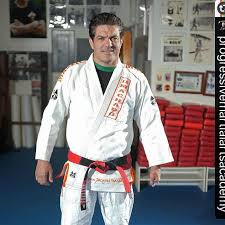
Jean Jacques Machado was born with amniotic band syndrome, leaving him with only a thumb and part of a finger on his left hand. In a sport obsessed with grips, he literally couldn’t play the same game, so he rebuilt it
Because he couldn’t rely on sleeve and collar holds, Machado became a master of underhooks, overhooks, body locks, and using his whole frame; chin, armpits, legs, to control people. Students and biographers describe his “handicap” as a secret weapon that forced him into deeply efficient leverage and connection. He won major titles and became one of the key figures bringing BJJ to the United States, especially on the West Coast.
He also mentored Eddie Bravo; that clinch-heavy style you see in 10th Planet; overhooks, closed distance, chest-to-chest control. Comes directly from trying to solve the no-gi problem without relying on traditional gi grips.
Pros: Machado shows that you can build world-class jiu-jitsu out of constraints, not in spite of them; perfect for older bodies, cops in kit, or anyone whose hands, shoulders, or fingers are cooked. His emphasis on connection, underhooks, and angle instead of fancy grips is incredibly transferable to self-defence and policing, where you don’t get to choose the clothing.
Cons: The downside is that a lot of people only copy the surface of his game; slick no-gi attacks, without absorbing the years of positional discipline and old-school fundamentals that make it work. It can feed a culture where everyone wants “magic” no-gi hacks, but few are willing to grind the boring basics that gave Machado his superpower in the first place.
He pushes us to ask: Am I using my limitations to sharpen my jiu-jitsu… or to excuse my lack of adaptation?
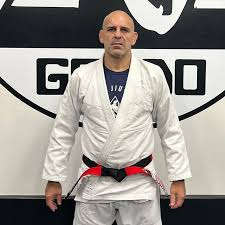
Chapter 4 – Roberto “Gordo” Correa: From Last Resort to Launchpad
Roberto “Gordo” Correa started jiu-jitsu in Rio at 15, influenced by Ralph Gracie, and was on the classic Gracie Barra path until disaster struck: as a purple belt around 1989, he tore his ACL badly enough that doctors advised him to quit. Closed guard and traditional movements were agony, so he had a choice; stop training or reinvent his game.
He chose reinvention. Forced to work from half guard to protect his knee, Gordo began developing sweeps, underhook battles, and back takes from a position that had previously been seen as a desperate, last-ditch stalling spot. He went on to become a multiple-time world champion and Brazilian national champion, earning a reputation as the “king of the half guard.”
Today, half guard is one of the most common positions in sport BJJ and MMA; entire instructionals and modern meta-games trace directly back to the innovations Gordo was building in the 1990s. In 2024, after 30 years as a black belt, he received his coral belt, cementing his status as a historic figure in the art.
Pros: Gordo proved that a “bad” position could become an attacking hub, opening a whole new tree of jiu-jitsu for smaller or injured grapplers, and for cops or security, who often end up tangled on one hip under pressure. His story is a blueprint for turning injury into innovation instead of an excuse to walk away.
Cons: Some old-school critics argue that a half-guard-heavy game can miss opportunities to stand up or dominate from top, especially for self-defence. In pure sport environments, over-specialising in deep half and inverted entries can create habits that don’t translate well when strikes, weapons, or multiple attackers are in play.
Gordo forces the question: Am I using modern guards to escape and attack… or am I hiding there from the parts of fighting I still fear?
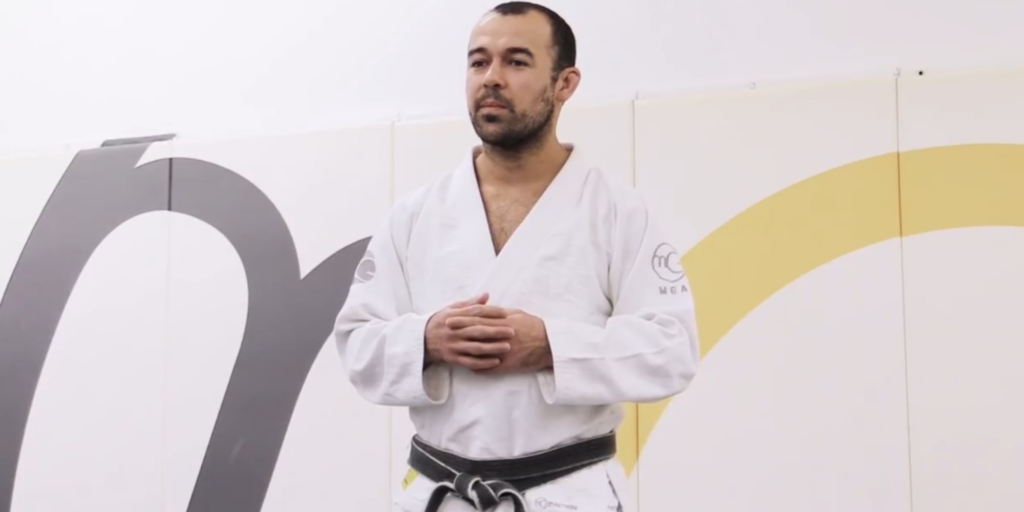
Chapter 5 – Marcelo Garcia: The Friendly Assassin of Modern No-Gi
Marcelo Garcia is often called the greatest pound-for-pound grappler of all time. A black belt under Fabio Gurgel at Alliance, he won four ADCC titles in no-gi and five IBJJF World Championships in the gi, all while usually moving up against larger opponents.
Ironically, he admits he initially hated training no-gi, he felt clumsy and exposed without the kimono and only adapted because Gurgel forced him through a hot São Paulo summer of no-gi rounds. That discomfort turned into mastery: Marcelo built a whole attacking ecosystem around butterfly guard, X-guard, single-leg X, guillotines, and back-takes that every modern no-gi competitor borrows from today.
He also became a beloved instructor, running his own academy and producing a generation of technically clean, submission-oriented athletes, while insisting that gi and no-gi complement each other instead of competing.
Pros: Marcelo showed that smaller, lighter grapplers could dominate with timing, off-balancing, and relentless back attacks rather than strength. His game is relatively “clean”; high percentage, fundamental movements dressed in smart angles, making it friendly to serious hobbyists as well as elites.
Cons: The shadow side is “Marcelo-cosplay”: people copy his sit-butterfly game without his intensity, wrestling timing, or hours of gi drilling, then wonder why they get smashed. And in some gyms, the obsession with his style feeds the broader sport-meta problem; lots of guard pulling and leg-entangling, not much stand-up or scenario work for self-defence or policing.
Marcelo asks us: Do I really want to play a smaller-fighter, open-guard meta… or would my body and job be better served by a simpler, pressure-heavier version of his ideas?
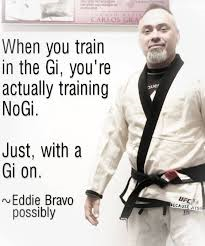
Chapter 6 – Eddie Bravo: The Maddest Scientist in the Room
Eddie Bravo started as a wrestler and martial arts experimenter in California, then became obsessed with BJJ after watching Royce Gracie in the early UFCs. He trained under Jean Jacques Machado, absorbing that clinch-heavy, overhook-driven no-gi style from a coach who literally couldn’t rely on traditional grips.
In 2003, still a brown belt, Eddie shocked the grappling world at ADCC by submitting Royler Gracie with a triangle choke in Brazil. He lost his next match badly on points, but that single upset became the seed for 10th Planet Jiu-Jitsu: a fully no-gi system built around Rubber Guard, the Twister, Lockdown half guard, and an unapologetically open-minded, “take what works for MMA and sub-only” mentality.
He later created the Eddie Bravo Invitational (EBI), a submission-only event with overtime rules that strongly favour attacking back and armbar positions, showcasing his style and giving his students a platform.
Pros: Eddie pushed BJJ to take no-gi and MMA seriously; no more pretending that gi grips exist in a cage. His system opened creative pathways for flexible, guard-oriented grapplers and broke the psychological monopoly about what was “proper” jiu-jitsu.
Cons: Critics argue that many 10th Planet positions are over-specialised for specific rulesets and body types, and that his students historically had less success in traditional IBJJF formats, leading to perceptions of a closed ecosystem. He’s also accused of rebranding existing moves with new names and building a strong “us vs them” culture, which feeds the “weird jiu-jitsu” label among traditionalists.
Eddie forces us to ask: Am I genuinely evolving my game for reality… or just chasing cool names and highlight-reel moves that only work under friendly rules?

Chapter 7 – The Upside: What These Innovators Gave All of Us
Taken together, these five innovators opened huge new branches on the jiu-jitsu tree. Carlson made competition-focused training, athleticism, and team strategy the norm, directly influencing modern MMA gyms like Brazilian Top Team and American Top Team. Gordo transformed half guard from a purgatory into an attacking platform, changing how bottom players survive and win.
Marcelo turned butterfly and X-guard into universal languages for lighter and older grapplers, while his guillotine and back-attack system gave us high-percentage finishes that don’t rely on strength. Machado’s underhook-and-leverage approach showed that even severe physical limitations can produce world-class jiu-jitsu that works without the gi. Eddie pushed no-gi and submission-only into the mainstream, forcing old schools to take serious grappling without the kimono and with leg-entanglement seriously.
Together they also drove cross-pollination: wrestling entries into guards and the Twister, judo-style off-balancing into butterfly and X-guard, MMA-driven demands on no-gi systems and control positions. They broke the illusion that one family, one academy, or one ruleset owned the definition of “real” jiu-jitsu.
For people like you and me; older, working, managing injuries. These innovations quietly created more options to adapt our games around our bodies and careers instead of trying to become a clone of a 1990s vale-tudo fighter.

Chapter 8 – The Downside: Meta Games, Narrow Ladders, and Culture Wars
But there’s a cost when innovation outruns context. Many of these systems shine brightest under specific rules: half-guard deep dives for IBJJF points, Rubber Guard for no-gi or MMA with minimal stand-ups, double-guard and berimbolo-style attacks for sport only.
When students copy only the “endgame” positions; Rubber Guard, fancy X-guard entries, obscure half-guard variations. Without solid posture, base, stand-up, and self-defence mechanics, their jiu-jitsu can become dangerously lopsided. You see hobbyists who can invert into single-leg X but freeze when someone body-locks them against a wall, or officers who know advanced chokes but can’t safely pin a wrist to control a resisting suspect.
Culturally, the splits deepen: traditionalists dismiss no-gi systems as unserious or “too weird,” while sub-only and 10th Planet-style camps mock gi schools as dinosaurs stuck in collar-choke land. Sport schools chase the latest IBJJF or ADCC meta; lapel guards one season, leg locks the next, often leaving older or recreational students behind.
So the tension becomes: are we building adaptable, pressure-tested jiu-jitsu for real lives… or chasing a moving target that only exists on tournament mats and Instagram?

Chapter 9 – Where Do You Fit in This Map-
If you’re listening to this, chances are you’re not a 19-year-old blue belt living in mum’s house and chasing ADCC dreams. You’re more like me: a migrant, a parent, a cop or nurse or tradie with a sore back and a crowded calendar, trying to stay dangerous and kind at the same time.
When you see Carlson-style competition clips, Gordo’s half-guard battles, Marcelo’s X-guard wars, or a 10th Planet highlight reel, it’s easy to feel behind; like real jiu-jitsu is always one meta shift away from what you actually do on your Tuesday night class. That’s not just a technical gap; it’s an identity gap.
Are you a “pure” self-defence grappler if you pull guard and chase heel hooks- Are you a “serious” jiu-jitsu student if you skip comps because night shifts and kids’ sport wreck your recovery- Do you belong in a gi school if you secretly love Rubber Guard memes-
The innovators made jiu-jitsu richer, but they also made the menu overwhelming. So before my take, ask yourself: What do you actually want jiu-jitsu to do for your life, and which pieces of these systems serve that, instead of your ego?
Chapter 10 – My Take: Gratitude, Boundaries, and a Third Way
Here’s where I land, as a former bare-knuckle guy, army vet, and retired cop who found BJJ the scenic route. I’m grateful to these innovators: Carlson for insisting on honest competition, Gordo for proving you can turn injury into offense, Marcelo for showing small guys can rule, Machado for turning limitation into superpower, and Eddie for forcing jiu-jitsu to confront no-gi and MMA reality.
But I don’t worship any of them. My body, my badge years, and my own Martial Arts philosophy don’t care about culture wars; pure vs sporty vs weird. I care about not getting concussed, about having a reliable escape when a drunk swings wildly, about being able to train next week.
So my “third way” is this:
- Steal their best ideas, not their entire identities; half-guard structure from Gordo, Marcelo’s off-balancing, Machado’s underhooks, Carlson’s honesty, Bravo’s creativity.
- Anchor everything in fundamentals that work in a car park, on a hospital floor, or in a cramped lounge room.
- Teach with clarity and games, not mystique; if I can’t explain it simply and pressure-test it safely with adults who have jobs and kids, it doesn’t belong in my core curriculum.
In other words: I respect the innovators who broke the monopoly on “correct” jiu-jitsu, but my job now is to build a version that protects my body, mind, and identity, not just my highlight reels.
Check out Episode 12 on Youtube: