

You can spend years training Brazilian Jiu Jitsu. You can spend thousands of dollars. You can travel across the world chasing academies. And still end up nowhere, learning nothing, because you are learning the wrong way from the wrong people.
This is the story of how I stopped chasing flashy techniques and started learning body mechanics. This is the story of how I found what I should have been taught on day one, the right teaching method.
White Belt Blues
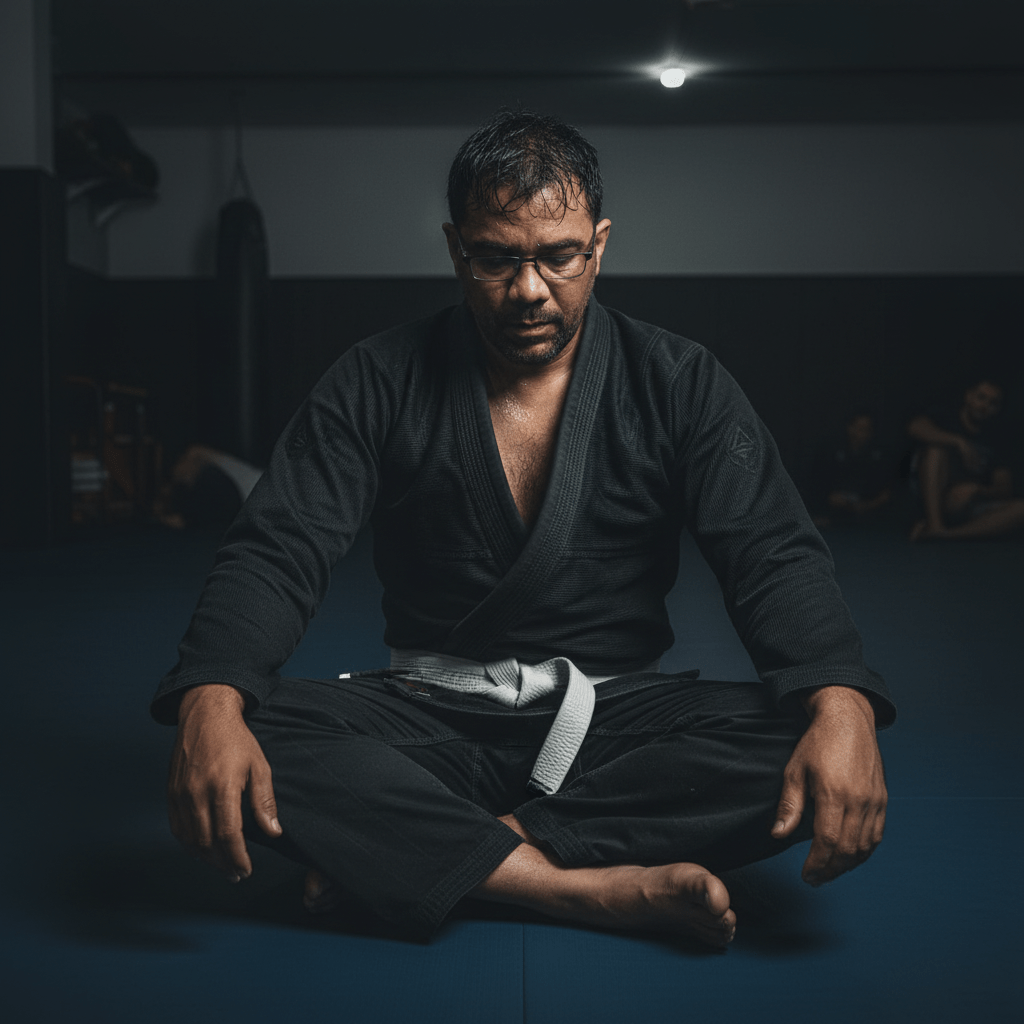
My white belt was not a gentle introduction to Brazilian Jiu Jitsu. It was a punishment.
I jumped from academy to academy across Greater Melbourne. Each one had the same formula: gruesome warm-up, followed by the random technique of the day, dead drill it for a few rounds, then roll to the death. Every class had a different technique. Every technique I learned was forgotten. My retention was zero.
Here is the thing nobody tells you about bad BJJ instruction: it does not just waste your time. It breaks your body.
My back and joints were constantly sore and every injury took longer to recover from. When you are in your fourties training against people in their twenties, your body does not bounce back like it used to. And when the academy treats rolling like a war, win every round, submission or nothing, your body pays the price.
I wasn’t learning anything because there was nothing coherent to learn. Just random scattered techniques from different instructors with different philosophies and different body types teaching me moves that did not suit my frame, my age, or my athleticism.
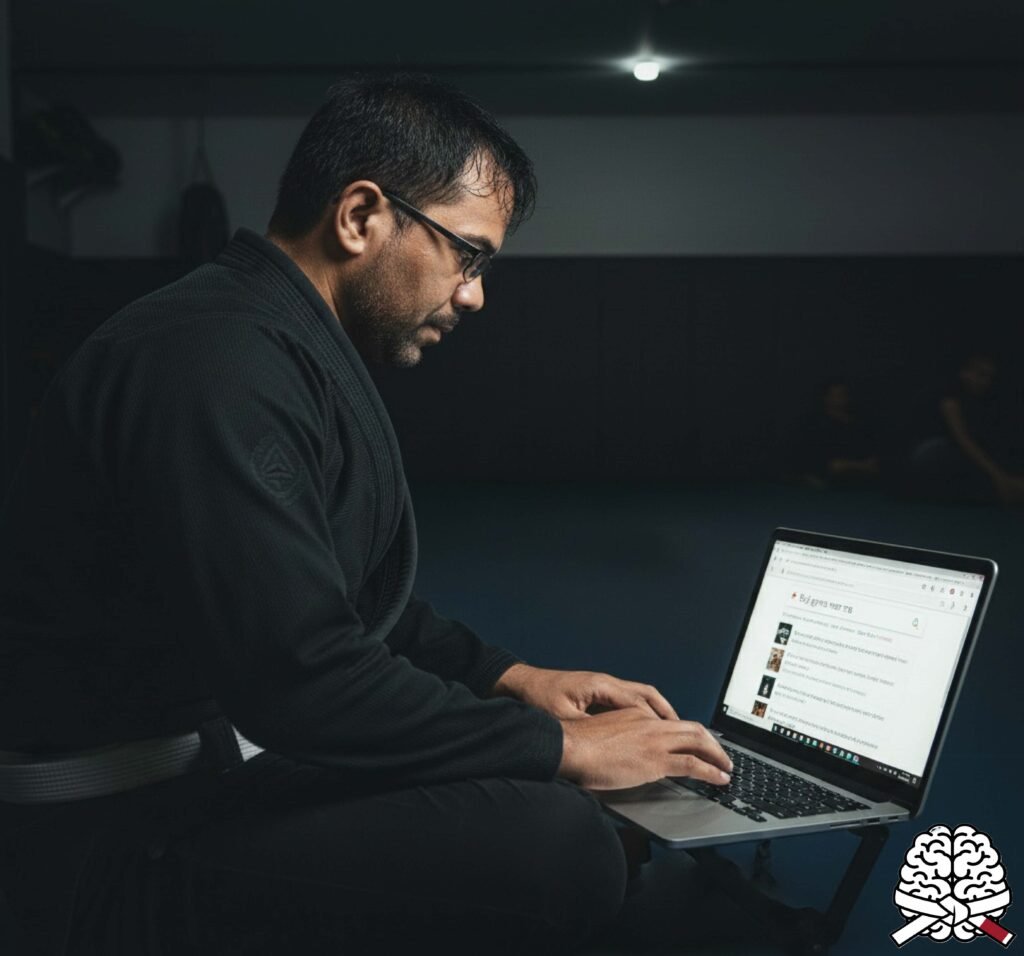
In all fareness, because the techniques shown were not applicable to me and threfore boring, I really just went to classes to spar, but I didn’t know enough so I went looking for answers on YouTube.
That was also the wrong way to learn. But at least I found techniques I could actually use.
The Ego & Bragging Rights
Here is where my big mouth became a problem.
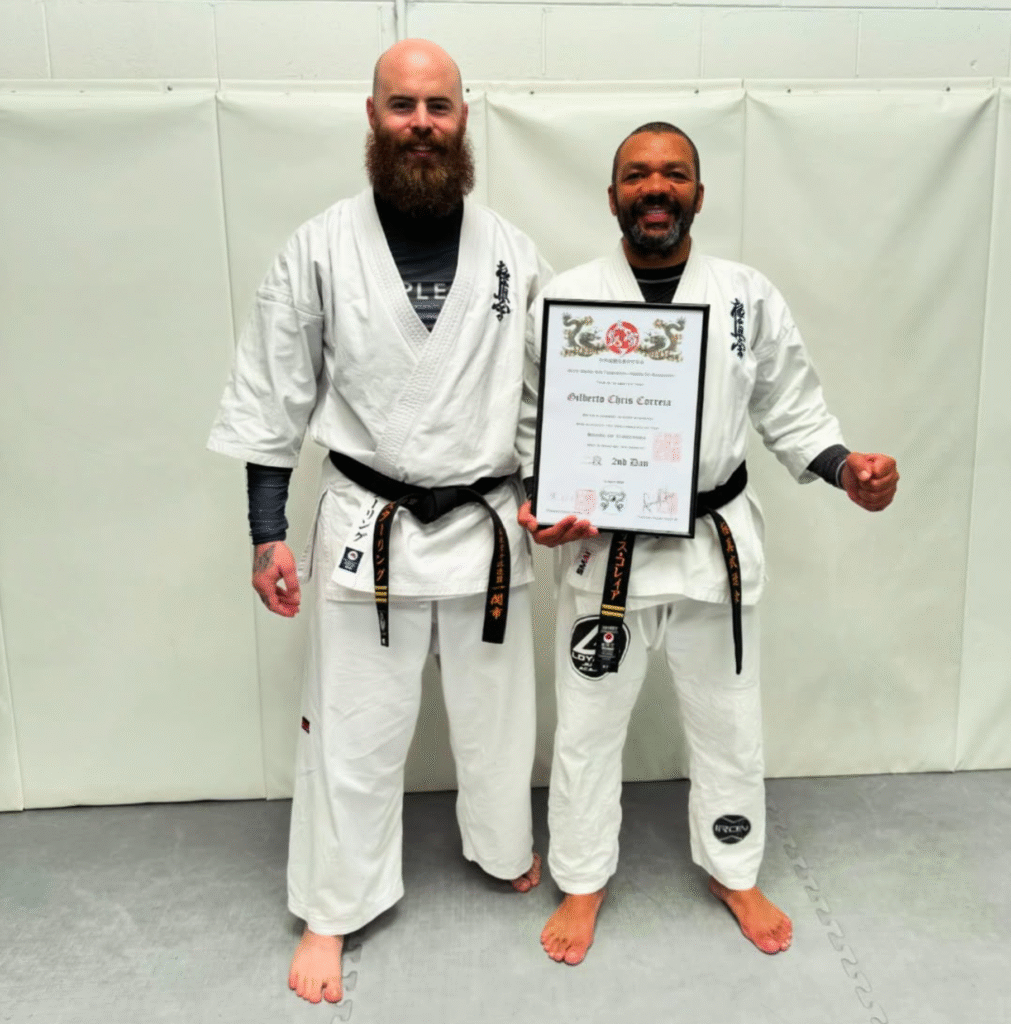
I was a karate black belt. I was an active police officer. Two decades of striking. One decade of authority. And now I was back to white belt.
So naturally, I told everyone.
“I am a black belt in Kyokushin and a cop.” You know what happens when you say that on the mat? Everyone wants to beat a karate black belt cop. Everyone wants to prove that BJJ is superior. Everyone wants to see if that uniform and that belt actually mean something in the grappling world.
Spoiler alert: they do not.
The stronger partners rag-dolled me. The weaker partners sensed blood in the water and faught me like I was trying trying to take away their freedom. I spent most of my rolls getting punished because I could not shut up.
But here is the real damage: I could not learn. I was too busy trying to win. I was too busy protecting my ego. I was too busy trying to use the one thing I thought I was good at, striking and foot work, in a sport that was designed for ground defence.
It was the striking mindset applied to grappling. And it was destroying me.

The Missing Link
After a longer than usual frustrating white belt period (started early 2010s and got my blue belt in 2020), something changed.
I came across BJJ Mental Models and Rob Biernacki’s BJJ Concepts.
This was the missing link.
Not another YouTube highlights channel. Not another “Technique of the Day” series. Not another academy promising me I would be a black belt in five years if I just signed for a monthly subscription.
This was a revolutionary way of teaching that was perfect for my learning style
Body alignment. Posture. Base. Levers. Fulcrum points. Wedges. These were not new techniques. These were not flashy submissions or complicated leg lock systems. These were the principles underneath all techniques. The architecture. The scaffolding that holds everything together.
The more I listened, the more it made sense to me. Not just intellectually, I am a thinking martial artist, an immigrant, a cop and former soldier. I need things to make sense. I need to understand the why. I need the framework.
But it also made sense physically. These concepts worked for my body. They worked for my age. They worked for my recovery rate. They worked for my joints.
For the first time in years of grappling, I was not just surviving. I was understanding.
Why Most Academies Get It Wrong
Let me be direct: the old outdated teaching method of showing a different random technique every single class and then “dead drill” it, does not work. Not for me and for most people. Especially not for older grapplers.
You show me a technique on Monday that does not suit my body type. I drill it five times without resistance. The following day we are shown a diferent unrelated technique. All this folowed by freerolling against someone who just wants to strangle or armbar me. The end of the week comes, I am sore and have not retained anything.
What am I supposed to retain anyways? What am I supposed to build on?
The instructors mean well. But some are still running classes like it is still 1995. They are teaching like everyone is a young athletic person with perfect flexibility and unlimited time to recover. They are teaching like everyone is there to compete in IBJJF rule set. Running fight clubs.
The real problem is deeper than the method though. It is the philosophy.
Most academies treat rolling like war. We must win every match. Get the submission. Beat the other person. There is no learning in that mindset. There is only survival. There is only winning and losing.
When you are caught in that loop, random techniques you cannot retain, rolling sessions where you are just trying not to die, there is no room to improve. Your body is too busy protecting itself. Your mind is too busy panicking. Your joints are too busy getting destroyed.
I spent years in that loop as a white belt. Injuries. Frustration. Zero progression. Building my identity as a martial artist on anything but grappling because I could not crack the code.
The code was never about the flashy Youtube techniques. The code was always about the undertanding my own body and be able to train techniques that actually worked for me.
The Turning Point
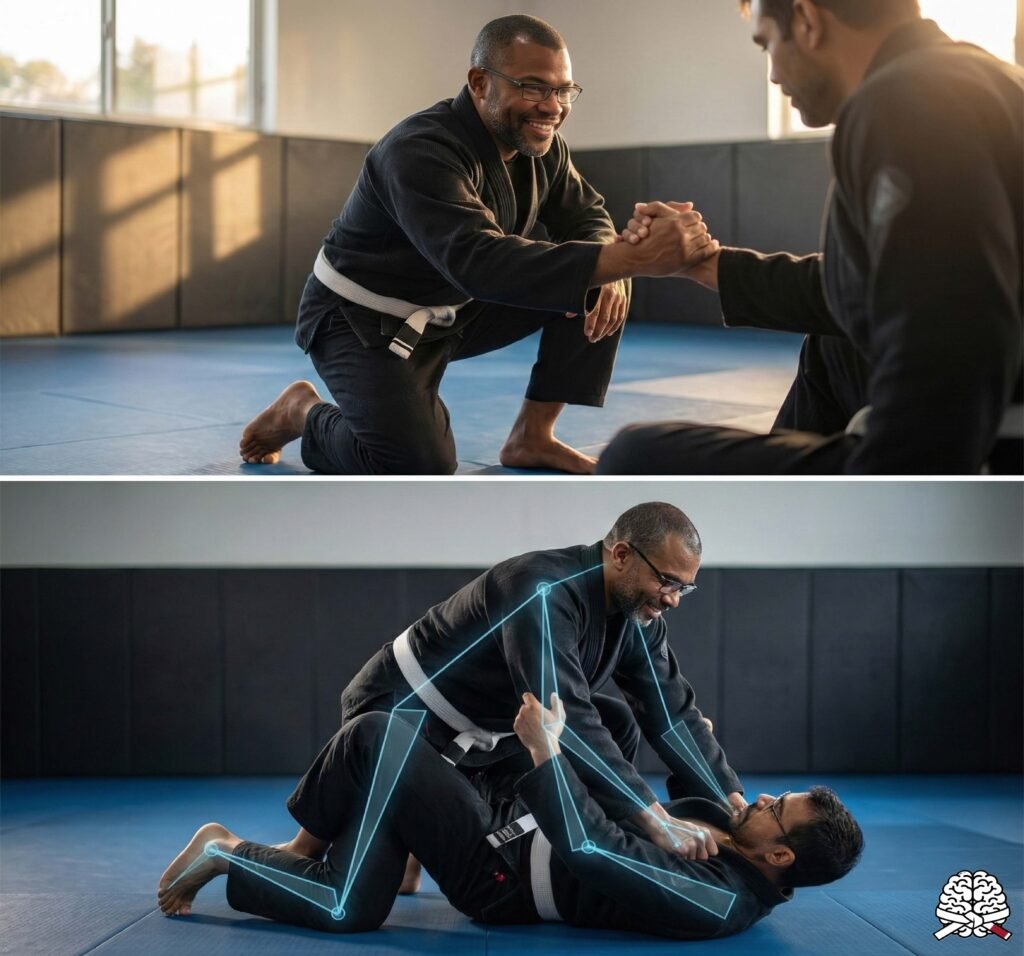
The real turning point was learning to stop trying to win every match.
Easier said than done. I know.
For decades, I trained in striking arts where the goal was clear: hit the other person and not get hit. In law enforcement, the goal was clear: control the situation and go home safe. Winning was literally survival.
But in Jiu Jitsu, especially when you are learning, winning is the enemy.
If you win every roll as a white belt, you are doing it wrong. You are using strength. You are using athleticism. You are using the one attribute that does not scale. You are learning bad habits that will cost you dearly at blue belt, purple belt, and beyond.
I had to unlearn the cop mindset. I had to unlearn the striker’s mentality. I had to learn that rolling was not about dominance. It was about investigation. It was about testing concepts. It was about failure being the fastest way to learning.
Rob Biernacki’s approach gave me permission to do that. It gave me a framework where losing a roll was not a failure, it was data. It was feedback. It was an invitation to understand body mechanics better next time.
When you train with concepts instead of random techniques, you do not have to win to learn. In fact, losing teaches you more. Ah, who would’ve known.
The Right Method for the Right Mind
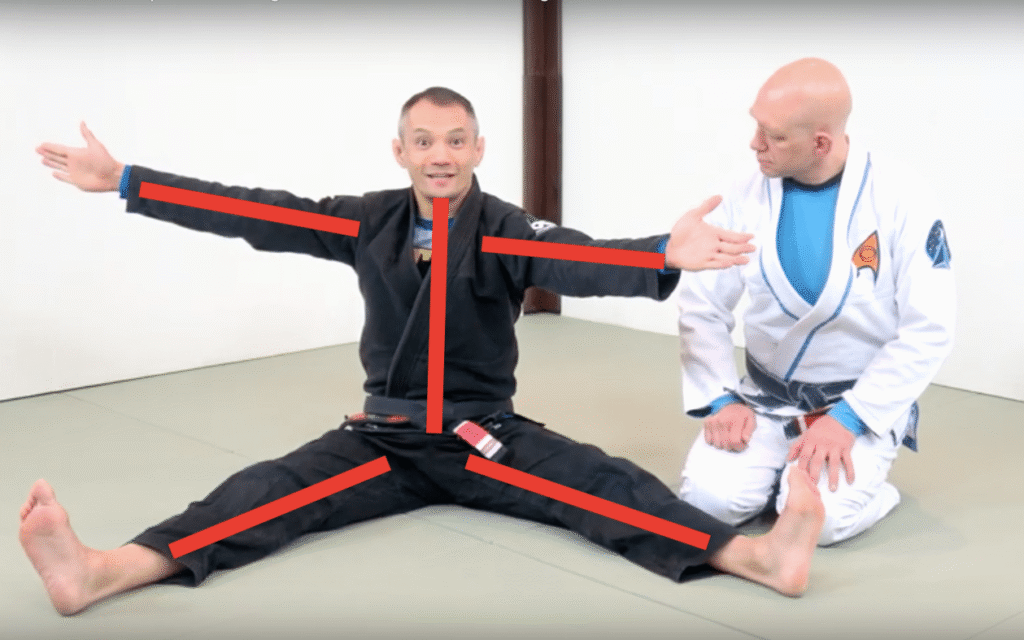
For me, learning body mechanics rather than individual techniques was the best approach. As a white belt, someone in their forties. As someone with a thinking mind that needs to understand the architecture.
Other people learn differently. I am not saying everyone should train like me. But I am saying that if you are jumping from academy to academy, if you are injured constantly, if you are not retaining anything, if you are still trying to win every roll because that is all you know, maybe the problem lies in the conventional teaching method.
Maybe you need someone who teaches you how to think instead of what to do.
Maybe you need to find someone who teaches body mechanics instead of flashy techniques.
Maybe you need to stop trying to win every single match.
I found that in Rob Biernacki’s approach. I found it in the concept of body alignment, posture, base, levers, fulcrums, and wedges. I found it in permission to fail, to learn, to rebuild my martial arts identity on something new.
The white belt carousel ended. The injuries slowed down. My retention improved. My rolling became less about dominance and more about discovery.
And for the first time in my grappling journey, I was not just training. I was learning and having fun.
The question was never: which academy should I join? The question was always: what method will actually work for my mind, my body, and my stage of life?
Once I found the answer, everything changed. Now as a blue belt I am loving my Jiu Jitsu journey.
Check out: https://bjjconcepts.net/
Check out: https://www.bjjmentalmodels.com/
Special shout out to my Karate & Grappling instructor and friend – Sensei Stirling Slaughter @ https://www.facebook.com/stirling.slaughter
Check out BJJ Mental Models @ https://www.bjjmentalmodels.com/
and BJJ Concepts @ https://bjjconcepts.net/