
A Critical, Respectful Examination of the Brazilian Jiu-Jitsu’s Founding Family
Hey there, welcome to Grounded Ramblings BlogCast!
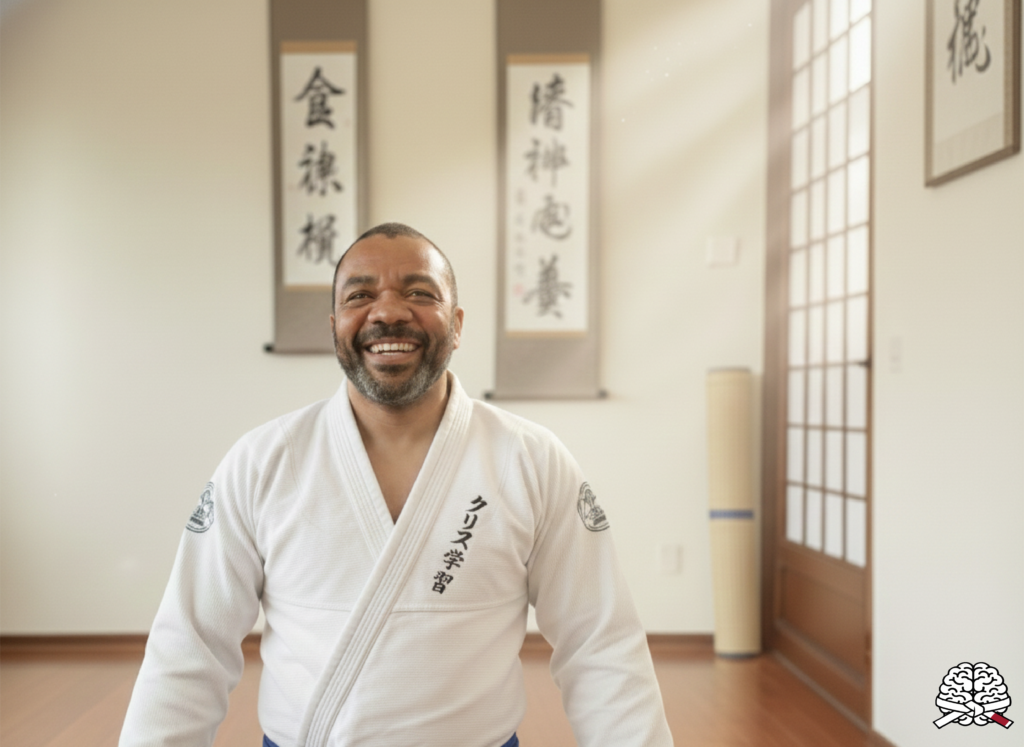
I’m Crish, an army veteran, retired cop, martial arts practicioner and solopreneur in my 50s, just trying to make sense of this wild world of Martial Arts one ramble at a time.
Today we step into The Gracie Era
By the end of the episode, you’ll learn why the Gracies sold jiu-jitsu as ‘for everyone’. The story behind their marketing strategy masterpiece
I’m not here to burn anything down, respect is owed, and I’ll give it. But real honor means looking at the full picture… cracks and all.
Stay tuned ’til the end and drop a comment.
Chapter 1
The Contradiction That Hooked Me
In the 2010s in Australia, when I was deep into Kyokushin karate’s hard contact, bone-on-bone sparring, something unexpected started happening.
Several of my older instructors, men in their 50s and 60s with decades of martial arts behind them, began talking about Brazilian Jiu-Jitsu.
They didn’t scoff at it. They didn’t dismiss it as a fad.
They spoke about it with a kind of cautious respect.
One of them told me, “BJJ is the ultimate martial art. The most difficult to master.”
But almost in the same breath, he added:
“I’m too old for that now. My back is always sore. My fingers are wrecked. My joints can’t take it.”
That contradiction stuck in my mind.
If BJJ was truly the ultimate martial art, why were these hard men, the kind who had survived decades of full-contact karate, backing away from it?
At the same time, the marketing message around Brazilian Jiu-Jitsu was very clear:
- “This is the art where the weak can defeat the strong.”
- “It’s for all ages and genders.”
- “It’s designed for the smaller, less athletic person.”
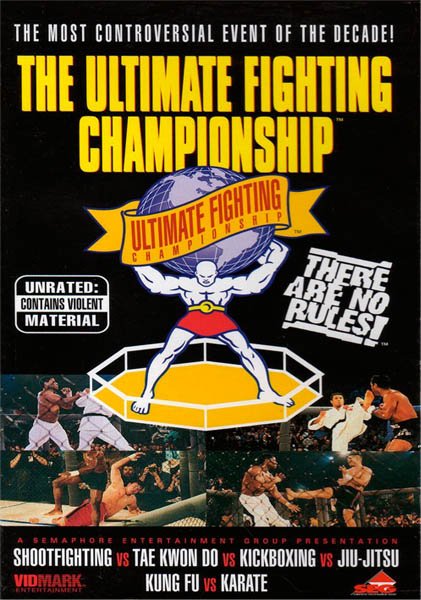
I’d seen Royce Gracie at UFC 1. I’d watched him strangle and submit men who looked bigger, stronger, and more dangerous on paper. It felt like proof that the Gracie family had solved the riddle of real fighting.
But here’s the tension:
If this art is truly for the weak, the older, the less athletic…
Why were my experienced instructors, who loved pressure-testing and toughness, choosing not to do it?
That question becomes the backbone of this episode.
Because to answer it, you can’t just look at the myth.
You have to look at what the Gracies actually built, how they trained people, what they left out, and how that early training culture collides with the reality of modern bodies, modern lives, and modern students.
Chapter 2
What the Gracies Really Invented
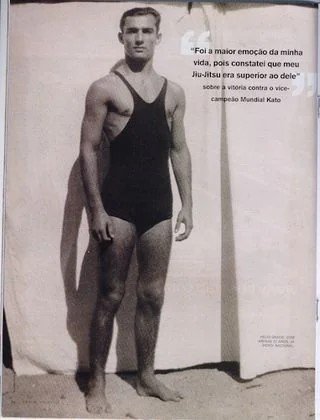
The classic Gracie origin story centers on a frail, undersized teenager named Hélio Gracie. Too weak to train, he sat in the corner watching, first his brother Carlos, and later other family members, teach the techniques they had learned from Mitsuyo Maeda (Count Koma).
One day, when Carlos was late for a private lesson, Hélio stepped in and taught the student from memory. When he later tried the moves himself, he found he couldn’t execute them with the same power his brothers could, so he began adapting them to rely more on leverage and timing than raw strength.
That’s the version Hélio told in interviews and that the family has promoted for decades.
The reality is more nuanced and, in important ways, more interesting.
First, the techniques Maeda taught Carlos were not traditional judo as practiced in Japan. Maeda was a professional challenge fighter who emphasized ground fighting (ne-waza) far more than the Kodokan did at the time. Leverage, timing, and off-balancing were already core principles. Hélio did not “invent” leverage.
Second, the “frail and forbidden to train” narrative appears exaggerated. Contemporary records and photos show a lean but active Hélio who swam, rowed, and trained intensely from his mid-teens onward. The story of lifelong physical weakness served a powerful marketing purpose: it proved that anyone, especially a smaller, weaker person, could win with the Gracie system.
What Hélio (and Carlos) actually did was far more specific.
They took the bottom position, what wrestlers treat as a loss, and judoka treat as a fleeting transition, and turned it into an offensive platform.
From the guard, you could:
- Control a larger opponent with your legs and hips.
- Off-balance them.
- Sweep them.
- Submit them.
That’s the real revolution: bottom position as a place of safety and attack.
In a world where most fighters had no idea what to do on the ground, that was a tectonic shift.
But notice something important: this innovation is very specific.
It’s not that the Gracies invented the perfect, complete martial art.
They developed a brilliant solution to a specific problem:
“How can a smaller person survive, and even win, from their back against someone bigger?”
That’s textbook business 101 marketing. Recognizing the innovation for what it actually was, rather than the broader myth of inventing “leverage beats strength”, gives a clearer picture of both the Gracies’ real contribution and the evolution of modern Brazilian Jiu-Jitsu.
Chapter 3
Five Gracies, Five Angles on Power
To really understand the Gracie era, you can’t treat “the Gracies” as one unified brain.
You have to look at individuals.
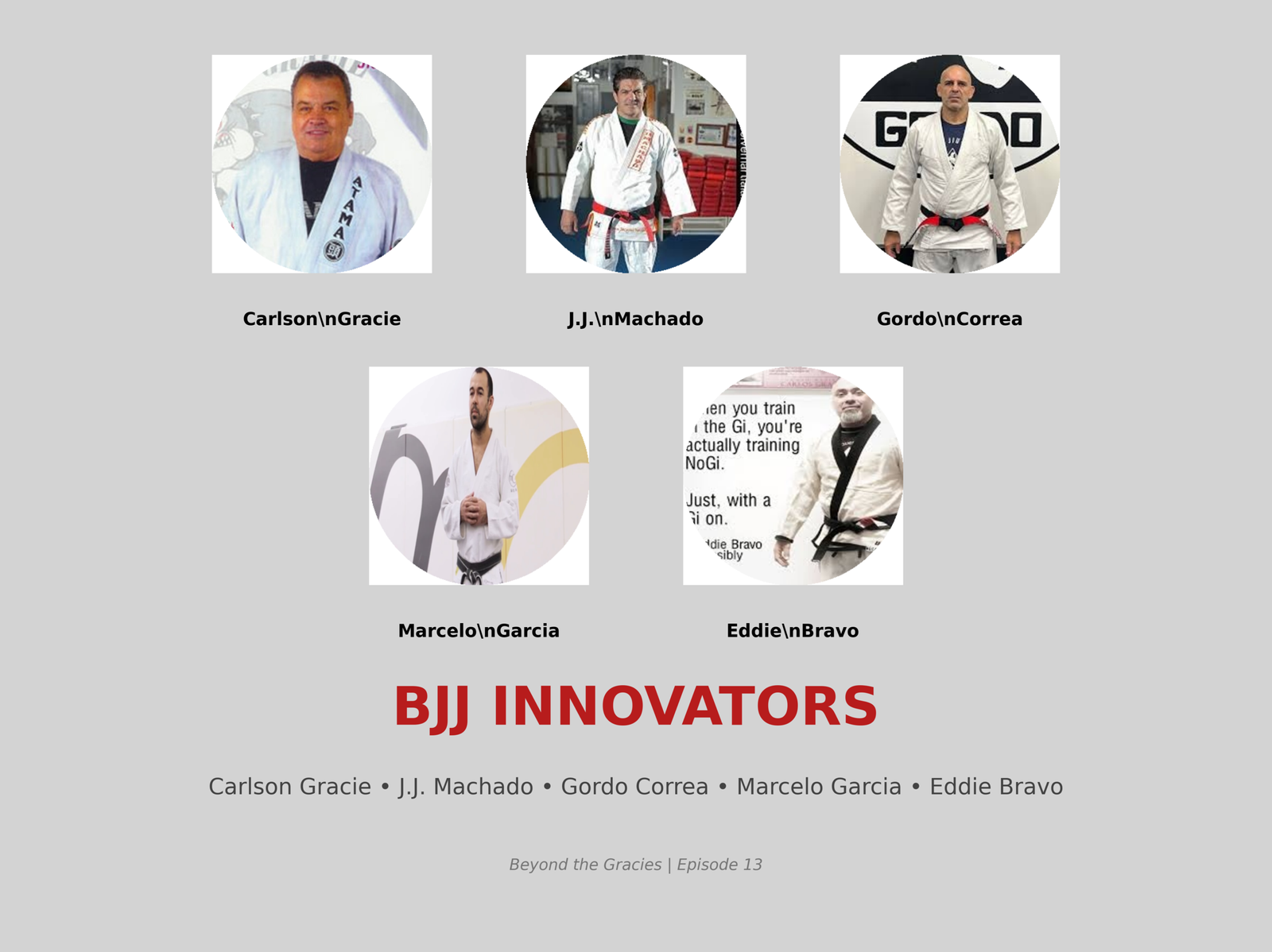
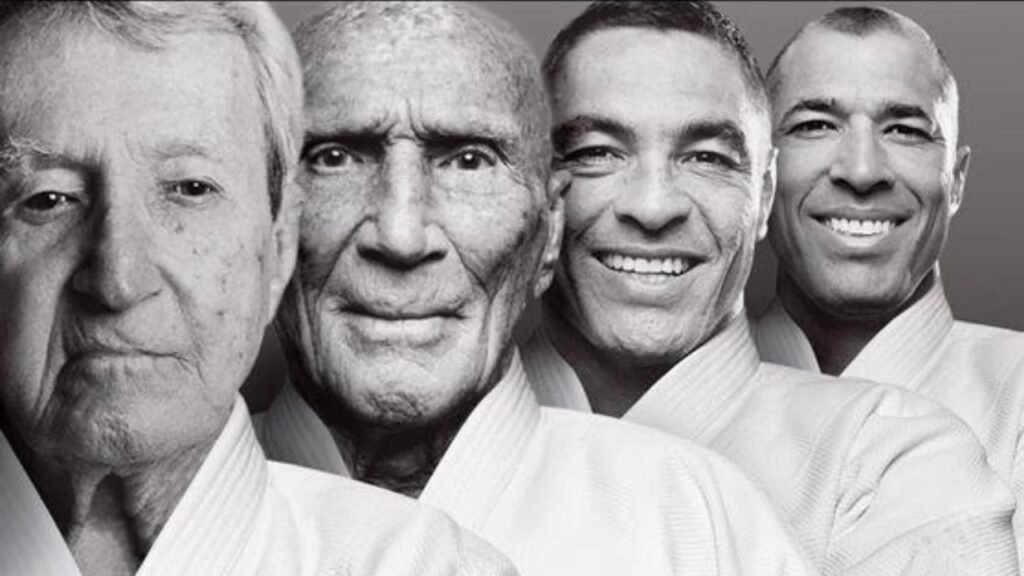
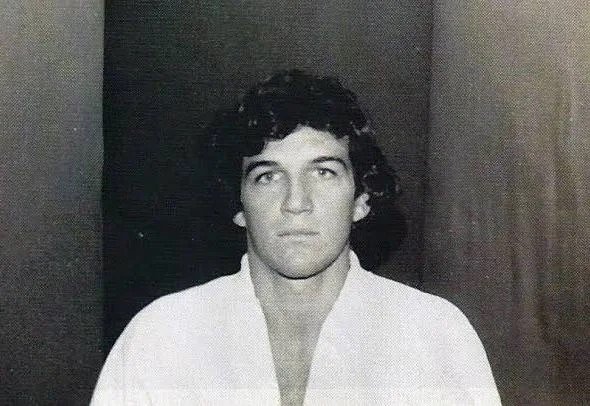
Each of the five figures in this episode—Carlos, Hélio, Rolls, Rickson, and Royce—represents a different angle on what jiu-jitsu is for.
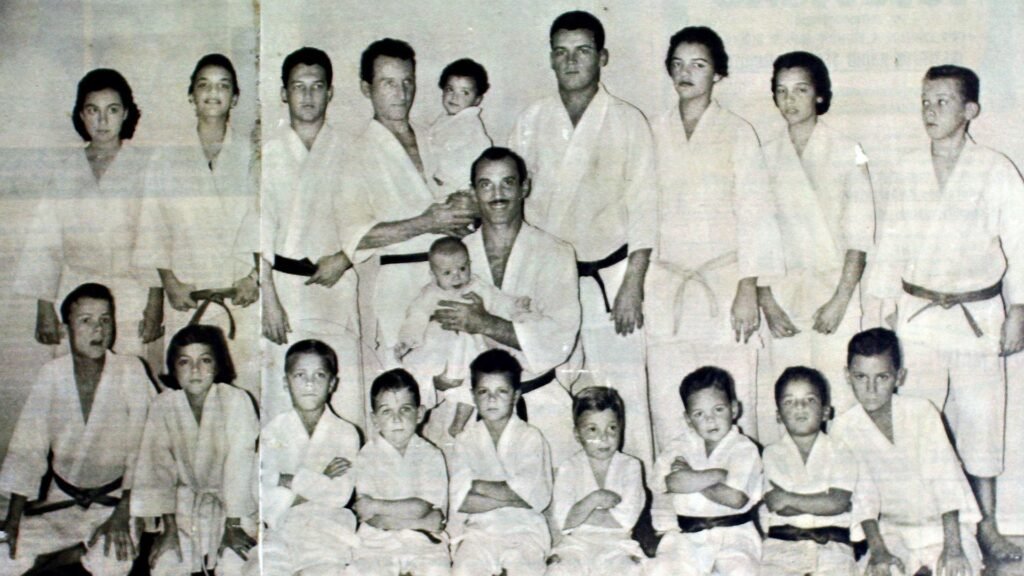
Carlos Gracie was the architect.
He learned from Maeda, opened the first academy in 1925, and turned jiu-jitsu into a family business. He wasn’t the main fighter; he was the organizer and strategist. Later, he became obsessed with diet and health, developing the “Gracie Diet” and treating food almost like a form of daily training.
Early on, his classes were not for the masses. They were private lessons for Rio’s upper class. Jiu-jitsu was a boutique service, not a drop-in hobby.
Hélio Gracie was the fighter and the technician.
He spent decades in vale tudo matches, essentially proto-MMA, using his system to prove effectiveness. He’s the one associated with the narrative of “frail boy who reinvented jiu-jitsu through leverage.”
But he also made a choice that would echo for generations: he dismissed certain techniques, especially leg locks, as “suburban,” a polite way of saying “low-class.” That prejudice against leg locks would later become hard-coded into competition rules.
Rolls Gracie was the disruptor.
He cross-trained in wrestling, judo, and sambo. He didn’t worship the family system as complete. He looked at what worked outside the Gracie bubble and brought it in.
Rolls is often called “the father of modern jiu-jitsu” for good reason. His philosophy was simple but radical for a Gracie: take what works from everywhere.
Rickson Gracie was the philosopher.
He focused on invisible details—weight distribution, breathing, timing—and on teaching people to feel jiu-jitsu, not just memorize moves. His approach is less “Do this step, then that step,” and more “Understand the principle inside the movement.”
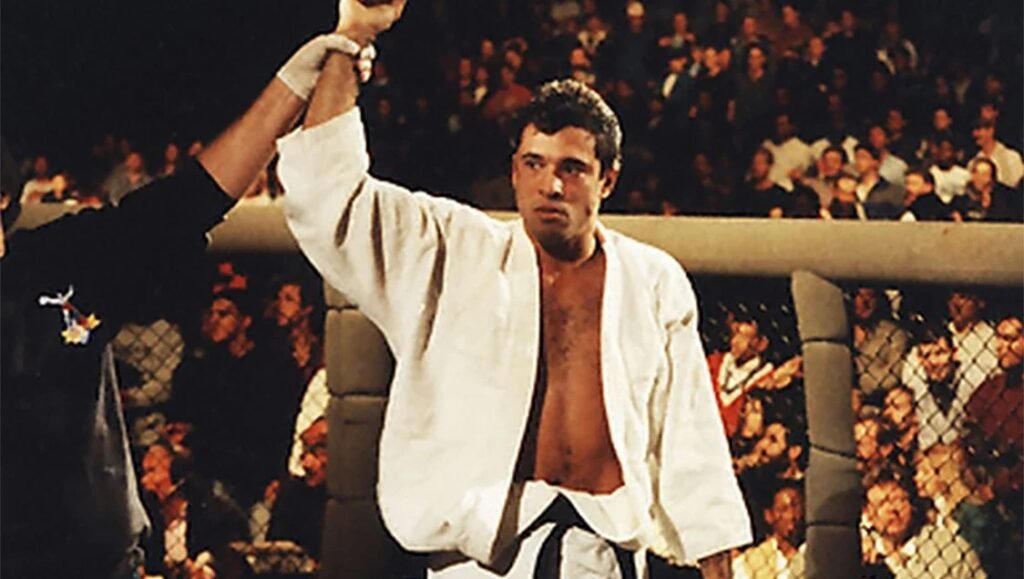
Royce Gracie was the proof-of-concept.
He was deliberately chosen, not because he was the best fighter in the family, but because he was small and slender. Putting him into UFC 1 was a strategic move: if the smaller Gracie could beat the giants on TV, the message was undeniable: “This art works.”
When you put these five together, a pattern emerges:
- Carlos: system and business.
- Hélio: technical adaptation and myth-building.
- Rolls: cross-training and evolution.
- Rickson: feeling and internal pedagogy.
- Royce: public proof.
This wasn’t a single genius. It was a family ecosystem, with different members pulling in different directions. Some towards purity. Some towards evolution. Some towards marketing.
Chapter 4
UFC: Proof or Illusion?
For my generation, UFC 1 felt like the apocalypse of martial arts illusions.
A skinny guy in a kimono strangled and submitted bigger, scarier men from every style you’d ever heard of.
Karate. Boxing. Savate. Wrestling. It didn’t seem to matter.
Royce Gracie walked into that cage, took everyone down, and finished them. No weight classes. Almost no rules. One night, three fights, three finishes.
On the surface, the conclusion seemed obvious:
Gracie Jiu-Jitsu is the ultimate martial art.
But when you slow the footage down and add context, a more precise picture appears.
Royce’s early opponents were:
- Specialised strikers with zero training in grappling.
- A boxer wearing one glove.
- Traditional martial artists who had never practiced takedown defense or submission escapes.
- A wrestler who understood grappling, but was fighting under no-time-limit, fatigue-heavy conditions that heavily favoured a patient guard player.
The rule set was also crucial:
- No time limits in UFC 1–3.
- No judges.
- No stand-ups.
- No stalling penalties.
Those conditions are a dream scenario for someone whose entire art is built on taking people down, tying them up, and waiting until they make a mistake.
When time limits were eventually introduced, the results shifted. Royce’s famous fight with Ken Shamrock at UFC 5… was a 30-minute draw.
Later, when Royce fought Hideki Sakuraba in Japan, the Gracie side pushed for special rules: unlimited rounds, no referee stoppages, no judges. In other words, “we’ll fight as long as it takes”, again leaning on attrition as a weapon.
So what did the early UFCs actually prove?
They didn’t prove that Gracie Jiu-Jitsu is the best art in every context.
They proved something narrower, but still extremely important:
- If you don’t know how to grapple, you are in existential danger against someone who does.
- If you don’t understand the ground, your striking becomes irrelevant as soon as you’re taken down.
- A rule set without time limits heavily favours a patient guard player who understands submissions.
The myth version says: “Gracie Jiu-Jitsu beats everything.”
The honest version says: “Gracie Jiu-Jitsu destroys untrained grapplers and single-discipline strikers under favourable rule sets.”
That’s still a powerful revelation. But it’s not the same thing.
Chapter 5
“For Everyone” Meets the Reality of the Mat
Now let’s come back to my instructors.
On the one hand, they believed what they’d seen:
- Royce showed that jiu-jitsu works.
- The Gracies showed that leverage and technique matter more than raw power.
On the other hand, they had real bodies and real lives:
- Decades of wear and tear from karate.
- Jobs. Families. Responsibilities.
- Fingers, knees, backs that already had mileage on them.
Then they encountered the training reality of BJJ.
Early Gracie-style training is not gentle. It’s rooted in a culture of:
- Frequent, intense live rolling.
- “Iron sharpens iron.”
- You prove yourself on the mat, under resistance.
For a 20-year-old athlete, that’s exciting. For a 50-year-old with a full-time job and prior injuries, it can be a fast track to chronic pain.
The promise of BJJ marketing is beautiful:
- “Zero fitness requirements.”
- “Technique over strength.”
- “For all ages.”
But the training environment in many early academies sent a different message:
- “Survive or quit.”
- “If you can’t roll hard, you’re not really training.”
- “Injuries are just part of the journey.”
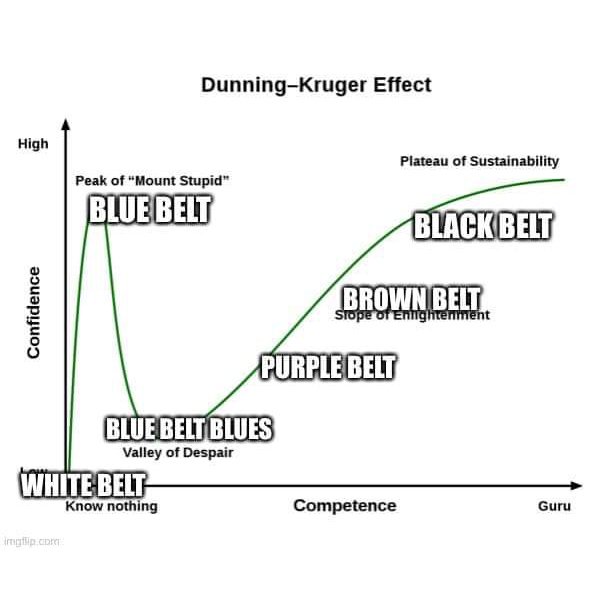
The data backs this up. Most people who start jiu-jitsu quit within the first year. A huge percentage never make it to blue belt. The drop-off from white to black belt is enormous.
So you end up with a paradox:
The system is sold as ideal for the weak and unathletic…
But the way it’s trained often punishes exactly those people the hardest.
That’s why Gracie Combatives and other modern beginner programs had to be invented later:
- Smaller technique sets.
- Cooperative drilling.
- Delayed hard sparring.
- More structure, less chaos.
In other words: the Gracie family had to reinvent the pedagogy to finally match the original promise.
Chapter 6
The Gaps: Wrestling, Leg Locks, and Blind Spots
If you only listen to the Gracie side of the story, you get the impression their system was complete from day one.
But the history of BJJ’s evolution tells a different story.
The Wrestling Gap
Wrestling brings:
- Explosive takedowns.
- Relentless top pressure.
- A culture of hard conditioning and scrambling.
Early Gracie jiu-jitsu focused heavily on the guard, on the bottom game, and on submissions. That was their edge.
But against elite wrestlers who could:
- Stay balanced.
- Avoid basic submissions.
- Maintain crushing top control…
…the Gracie toolkit was suddenly under stress.
Rolls saw this clearly. That’s why he trained with high-level wrestlers and brought that skill set into his jiu-jitsu. He wanted to be dangerous from everywhere, not just from guard.
The Leg Lock Gap
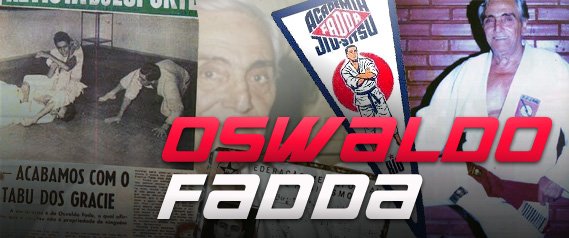
The story of Oswaldo Fadda is even more telling.
Fadda came from a different branch of Maeda’s lineage and developed a style that emphasized leg locks. In a famous challenge match in the 1950s, his team faced the Gracie academy. Many accounts say Fadda’s students won the majority of the matches, primarily using footlocks.
The Gracie response wasn’t:
- “Interesting, these techniques are powerful. Let’s study them.”
It was:
- “These are low-class techniques.”
- “Suburban moves. Not refined.”
And then, over time, competition rules evolved in a way that:
- Restricted leg locks.
- Banned certain positions outright.
- Protected the dominant Gracie style and de-emphasized what had beaten them.
Decades later, the leg lock revolution in no-Gi grappling showed how incomplete that approach was. Once rules allowed them, and coaches taught them systematically, leg locks became one of the most feared and effective tools in modern grappling.
That’s not a story of a complete art revealed. It’s a story of an art with blind spots, slowly being forced to evolve.
Chapter 7
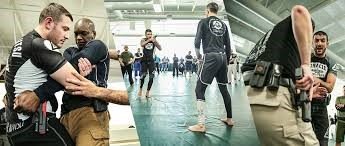
Why Cops Fell in Love with Jiu-Jitsu
For all its gaps and politics, there’s a reason Brazilian Jiu-Jitsu became so important in law enforcement and self-defence circles.
It answered a very specific problem that most striking arts didn’t:
“How do I control a resisting person safely, without punching them senseless, and without relying on pain compliance that fails when adrenaline is high?”
In the police context, you:
- Often can’t just strike someone repeatedly.
- Need to manage a suspect’s limbs and posture.
- Must prevent them reaching weapons, yours or theirs.
- Are accountable for visible injuries and unnecessary force.
The Gracie approach of:
- Clinch.
- Off-balance.
- Takedown.
- Control on the ground.
- Isolate an arm or the neck.
…gave officers a framework that worked under pressure.
Gracie Survival Tactics, designed specifically for law enforcement, added layers that early Gracie self-defence didn’t fully address:
- Weapon retention.
- Multiple attacker awareness.
- Confined spaces.
- Legal and ethical considerations.
That’s where jiu-jitsu shines: controlled force, under resistance, with reliable mechanics.
My own experience in policing confirmed that. Traditional striking-only training wasn’t enough. Grappling filled that gap in a way nothing else did.
But even here, context matters.
Jiu-jitsu works brilliantly:
- One-on-one.
- When you’re not outnumbered.
- When you can manage distance and position.
It’s not a magic spell for every street scenario. It needs rule awareness, environmental awareness, and, ideally, integration with striking and disengagement tactics.
Chapter 8
How the Gracie System Evolved Past Itself
Over time, the very success of jiu-jitsu forced it to evolve.
We can roughly map the phases like this:
Phase 1 – Proving the System
- Hélio’s vale tudo fights.
- Gracie challenge matches.
- Early UFCs.
- Emphasis: “Does this work?”
Pedagogy: Hard sparring, survival culture, very little concern for retention or accessibility.
Phase 2 – Expanding the System
- Rolls introduces wrestling, judo, sambo.
- Carlson builds a lineage of aggressive, top-focused fighters.
- Sport jiu-jitsu emerges: tournaments, point systems, team rivalries.
Pedagogy: Still hard, still intense, but with more technical cross-pollination.
Phase 3 – Systematizing and Scaling
- Gracie Barra and similar teams build structured curricula.
- Classes are segmented into fundamentals, advanced, competition, etc.
- Belt paths are created, curriculum-based teaching becomes normal.
Pedagogy: More system, more structure, more focus on keeping students than just breaking them.
Phase 4 – Retention and Accessibility
- Gracie Combatives and similar programs are built for total beginners.
- Cooperative drilling and delayed sparring are introduced.
- Jiu-jitsu is intentionally made less intimidating at the start.
Pedagogy: Now truly aimed at “everyone,” not just the naturally tough and athletic.
This evolution tells us something very clear:
If the original Gracie jiu-jitsu had perfectly matched its own marketing—
If it were truly “for everyone” in both theory and practice—
There would have been no need for all these later pedagogical reinventions.
The core mechanics were always powerful. But the teaching methods had to catch up.
Chapter 9
What the Gracie Era Really Teaches Us
So what do we actually learn from the Gracie era, if we strip away the hero worship and family mythology?
- Leverage and position beat raw strength, if you are trained.
The guard, the mount, the back, these positions changed how the world thought about fighting. - Rule sets shape reality.
No time limits, no judges, no stand-ups—these are not neutral. They favour certain strategies and certain arts. - No system is complete from day one.
Wrestling, leg locks, and modern pedagogy all had to be added, often from outside the original Gracie bubble. - Marketing and training reality can diverge.
“For everyone” sounded great. The mats told a harsher story until pedagogy evolved. - Adaptation beats dogma.
Rolls cross-training, Carlson’s top game, Barra and Combatives’ structures, leg lock specialists—all of them pushed jiu-jitsu past its own limitations.
For you as a modern practitioner, or as a coach, the lesson is not:
“Worship the Gracies.”
The lesson is:
- Respect the genuine innovation.
- Question the mythology.
- Be honest about who your training actually serves.
- Design your pedagogy to match your promises.
If you tell people jiu-jitsu is for everyone, you must build a training environment that genuinely lets everyone participate safely and meaningfully.
The Gracie era was not the final word on jiu-jitsu.
It was the opening chapter.
Chapter 10
My Take on the Gracies
I feel li I do owe a lot to the Gracie family, and I don’t say that lightly.
Without their system, I probably wouldn’t have stayed in martial arts the way I did. Jiu-jitsu gave me answers that striking alone never could, especially in policing and real confrontations. It showed me that control, patience, and position can beat panic and aggression. That’s a gift I carry on the mats every week.
For me, the pros are clear:
They proved that leverage and positioning can let a smaller, calmer person survive real violence. They dragged the martial arts world, kicking and screaming, into the age of pressure-testing. And they inspired a generation of students, myself included, to care less about pretty techniques and more about what actually works against resistance.
But there are cons I can’t ignore.
The family mythology sometimes crowds out the wider history. Brilliant rivals like Fadda, or the influence of wrestling and sambo, were pushed to the margins. Their control over rules and narratives slowed down the development of leg locks, takedowns, and more modern training ideas. And the way jiu-jitsu was sold as “for everyone” often ignored the reality that many bodies and many life situations, can’t survive a sink-or-swim sparring culture.
On my own jiu-jitsu journey, the Gracies are both foundation and filter.
They gave me the base, guard, mount, positional hierarchy, the idea that technique must work under stress. But I don’t treat their way as sacred. I treat it as version one. I’ve added to it: wrestling, grappling concepts, modern leg locks, ecological-style training, safer progressions for adults with jobs, kids, and previous injuries.
So my take is simple:
- I’m grateful for what they built.
- I’m honest about what they distorted or delayed.
- And I refuse to freeze jiu-jitsu in their era.
The best way I can honour the Gracie legacy is not by repeating their stories, but by doing what the best of them did: testing, questioning, adapting and building a version of jiu-jitsu that actually fits the lives of the people I train with, teach and inspire.